
Every June, the question surfaces again across South Florida: am I actually covered if a hurricane hits? The honest answer is more complicated than most homeowners realize, and the gap between what people assume their policy covers and what it actually pays has cost Floridians billions of dollars in uncovered losses over the past decade.
Yes, you can get hurricane insurance in Florida. But there is no single policy called “hurricane insurance.” Coverage for hurricane damage is assembled from multiple policies that each handle a different piece of the risk. Getting that assembly right, before a storm forms, is what separates a full recovery from a financial crisis.
This guide explains how hurricane coverage works in Florida, what your homeowners policy actually pays for, what it does not touch, how condo insurance works differently, and what to do when your insurer disputes your claim.
Is Hurricane Insurance Required in Florida?
Florida law does not use the term “hurricane insurance” in its requirements. What the state does require is more specific.
Is hurricane insurance required in Florida? Not as a standalone policy. But Florida law requires that any homeowners insurance policy covering wind damage must include a separate hurricane deductible. If your policy covers wind, a hurricane deductible applies automatically, and insurers are required to offer deductible options of $500 flat, 2 percent, 5 percent, or 10 percent of the dwelling’s insured value.
For homeowners with a mortgage, lenders require property insurance that includes wind coverage. Lenders in flood zones additionally require flood insurance through the NFIP or a private flood insurer. Together, these lender requirements effectively mandate the core components of hurricane protection, even though no Florida law specifically uses the phrase “hurricane insurance.”
For Citizens Property Insurance policyholders, a notable 2026 change applies. Effective January 1, 2026, Citizens policyholders with homes insured above $400,000 in dwelling coverage must carry flood insurance to maintain their Citizens wind coverage. Policyholders near or above that threshold who have not yet added flood insurance should verify compliance before their next renewal.
What Does Hurricane Insurance Cover in Florida?
Because hurricane protection is not a single product, understanding what does hurricane insurance cover in Florida means understanding what each component policy handles.
Wind Damage: Covered by Your Homeowners Policy
Your standard Florida homeowners policy covers wind damage from named hurricanes and tropical storms. This includes:
- Roof damage from wind, including shingle loss, ridge cap displacement, and deck damage
- Structural damage to walls, siding, and windows caused by wind or wind-borne debris
- Wind-driven rain that enters your home through a wind-created breach, such as rain entering through a torn roof section or broken window
- Detached structures on your property, such as a garage or fence, up to the sublimit in your policy
What matters here is the cause of the opening. If wind damages your roof and rain then enters through that damaged area, your homeowners policy covers both the roof repair and the resulting interior water damage. If rain enters through a door or window that was not physically damaged by wind, coverage is much less certain and is frequently disputed.
The Hurricane Deductible: What It Actually Costs You
The hurricane deductible is separate from your standard deductible and applies specifically when a named hurricane causes your loss. It is calculated as a percentage of your home’s insured dwelling value, not a flat dollar amount.
On a home insured for $400,000 with a 5 percent hurricane deductible, you pay $20,000 before your insurer pays anything. On the same home with a 2 percent deductible, you pay $8,000. The standard deductible for non-hurricane wind events might be $1,000 or $2,500, a fraction of what the hurricane deductible requires.
The hurricane deductible applies whenever the National Hurricane Center officially designates the storm as a hurricane. Tropical storms that cause significant damage but never receive a hurricane designation trigger the standard deductible instead, which is substantially lower.
Flood Damage: Not Covered by Any Standard Homeowners Policy
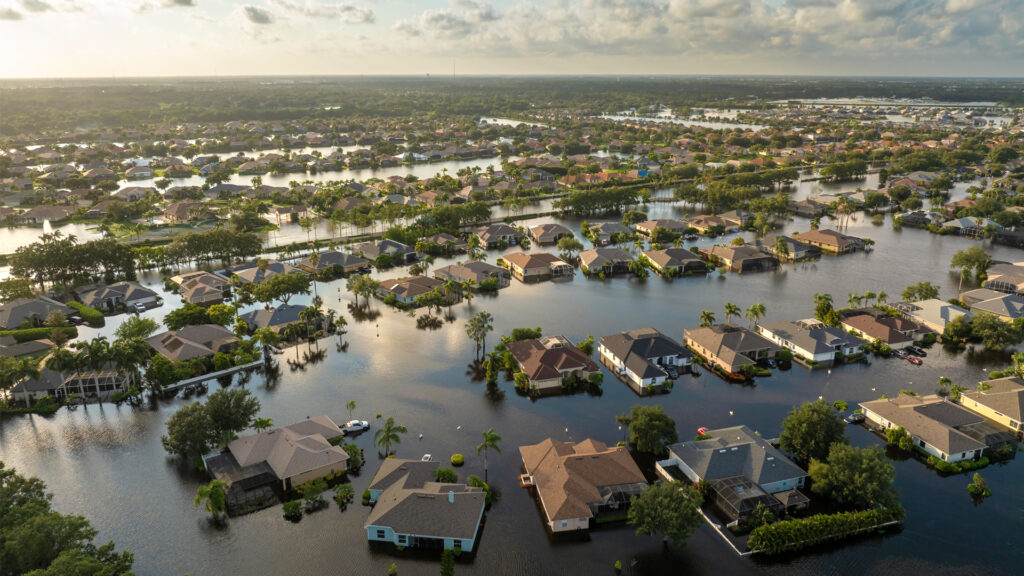
This is the gap that surprises more Florida homeowners than any other. Storm surge, rising water from heavy rainfall, overflowing waterways, and coastal flooding are all categorized as flood damage. No standard homeowners policy covers flood damage, regardless of the storm that caused it.
A standard homeowners policy in Florida covers wind damage only. Storm surge from a hurricane is flood damage, not wind damage, even if a hurricane caused the surge. This distinction cost thousands of homeowners their full recovery after Hurricane Ian in 2022, when storm surge produced losses that their homeowners policies flatly excluded.
Flood insurance must be purchased separately through:
- The National Flood Insurance Program (NFIP): A federal program offering flood coverage up to $250,000 for the dwelling and $100,000 for personal contents
- Private flood insurance: Higher limits, broader coverage terms, and sometimes faster claims processing, available through admitted and surplus lines carriers
Flood policies have a 30-day waiting period before they take effect. Purchasing flood insurance after a hurricane threatens is not possible. This must be in place well in advance of hurricane season.
Additional Living Expenses
If hurricane damage makes your home uninhabitable, your homeowners policy typically includes additional living expenses (ALE) coverage. This pays for hotel costs, temporary rental housing, meals, and other reasonable expenses while your home is being repaired, up to the policy sublimit and time limit. Confirm both the dollar limit and the time limit on your ALE coverage before storm season.
What Standard Homeowners Policies Do Not Cover
Beyond flood damage, there are several other hurricane-related losses that standard policies exclude or significantly limit:
Mold following water damage. Florida’s heat and humidity mean mold can develop within 24 to 48 hours of a roof breach or water intrusion. Many policies limit mold remediation coverage to $10,000 or less, which is rarely enough for a significant mold remediation project in a Florida home.
Screened enclosures and screen rooms. Policies frequently limit or exclude pool enclosures, screen rooms, and attached screened structures, which are common in South Florida and among the first things damaged in a storm.
Matching and cosmetic repairs. If a storm damages part of your roof and the materials required to match the original are no longer available, your insurer may only be obligated to replace the damaged section, not the entire roof. This is one of the most frequently litigated issues in Florida hurricane claims.
Land and landscaping. Trees, shrubs, and soil are not covered under standard homeowners policies. If a hurricane strips your property of mature landscaping, that loss is yours.
Condo Hurricane Insurance Claims in Florida: A Different Set of Rules
Condo hurricane insurance claims in Florida operate under a two-policy system that creates confusion and disputes every hurricane season. Understanding how this works before a storm arrives is essential for any condo owner.
The Master Policy: Your Association’s Coverage
Your condominium association maintains a master insurance policy that covers the building structure, roof, exterior walls, common areas, and in many cases the systems and fixtures within the units as originally built, sometimes referred to as “bare walls-in” or “all-in” coverage depending on your association’s governing documents.
When hurricane winds damage the roof, break windows in the building exterior, or damage common areas, the master policy responds. The association files the claim, manages the repair process, and handles communications with the master policy carrier.
The challenge for unit owners is that the master policy often carries a hurricane deductible calculated as a percentage of the entire building’s insured value. On a mid-sized condominium building insured for $10 million, a 3 percent hurricane deductible means $300,000 must be paid before the master policy pays anything. That shortfall can be passed to unit owners as a special assessment.
Your HO-6 Policy: The Unit Owner’s Coverage
Your individual HO-6 condo unit owner’s policy covers:
- Interior structure from the drywall inward, including flooring, cabinetry, and fixtures
- Personal property such as furniture, electronics, and clothing
- Improvements and betterments you have made to the unit, such as upgraded countertops or custom flooring
- Personal liability coverage if someone is injured in your unit
- Additional living expenses if your unit becomes uninhabitable
- Loss assessment coverage, which pays your share of a special assessment levied by the association after a major loss
Loss assessment coverage is among the most important components of an HO-6 policy in Florida. When a hurricane triggers a master policy deductible that the association cannot cover from reserves, the shortfall is divided among unit owners. Without adequate loss assessment coverage on your HO-6, that assessment comes entirely out of pocket.
Where Condo Hurricane Claims Get Disputed
The most common source of condo hurricane insurance claim disputes in Florida is the line between what the master policy covers and what the HO-6 should cover. After a roof breach sends water into multiple units below, disputes arise quickly:
The association’s master policy carrier points to the unit owner’s HO-6 for interior damage. The HO-6 carrier points to the master policy for damage originating from the roof and building envelope. The unit owner stands in the middle of two carriers, each with an incentive to reduce its own payout.
These disputes are not resolved by goodwill. They require review of the association’s governing documents, the master policy’s coverage form, and the specific language of the HO-6. What the association’s documents define as a “unit” versus “common elements” is the starting point for any allocation dispute.
If you are a condo owner, obtain a copy of your association’s master policy declarations page and confirm whether the coverage is “bare walls-in” or “all-in.” Your HO-6 should be structured to fill the gap between where the master policy stops and where your personal liability begins.
The Florida Hurricane Damage Insurance Dispute Process
If your hurricane claim is denied, underpaid, or delayed, you are not without options. Florida law provides a structured hurricane damage insurance dispute process that moves through several stages before reaching the courtroom.
Step 1: Document Everything Immediately
Before any dispute begins, your ability to recover depends on your documentation. Photograph all damage with date-stamped images, video the interior and exterior of the property, and begin a written log of every communication with your insurer. Keep copies of all repair estimates, contractor invoices, and any temporary repair receipts.
Your policy’s “duties after loss” section requires you to take reasonable steps to prevent further damage, such as tarping a damaged roof. Keep receipts for every protective measure you take. These expenses are typically reimbursable under your policy and documenting them supports your overall claim.
Step 2: Report the Claim Promptly and in Writing
Under Florida’s current law, homeowners have one year from the date of loss to file an initial claim, down from two years under prior law. Supplemental claims for additional damage discovered after the initial filing have an 18-month window. Missing these deadlines can result in a complete denial regardless of the underlying merits of the claim.
Report your claim in writing, not just by phone. Confirm the claim number and the assigned adjuster’s contact information in writing.
Step 3: Request the Insurer’s Basis for Denial or Underpayment
If your insurer denies your claim or offers a settlement you believe is too low, request the insurer’s claim file and the specific basis for their determination in writing. Insurers must acknowledge your claim within 14 days and issue payment or deny within 60 days of receiving proof of loss under current Florida law.
Obtain an independent contractor estimate or a public adjuster’s assessment of the damage before accepting any settlement offer. The insurer’s adjuster works for the insurer. Their scope of damage estimate may not reflect the full cost of a proper repair.
Step 4: Invoke the Appraisal Process
Most Florida homeowners policies include an appraisal clause. When you and your insurer disagree on the amount of loss, either party can demand appraisal. The process works as follows:
Each party selects a licensed, independent appraiser. The two appraisers attempt to agree on the amount of the loss. If they cannot agree, they jointly select an umpire. A decision agreed to by any two of the three becomes binding on the amount owed.
Appraisal is faster and less expensive than litigation. It resolves disputes over the dollar value of the loss, not over whether the loss is covered. If the insurer is denying the claim outright rather than disputing the amount, appraisal is not the right tool. Coverage disputes require a different approach.
Step 5: Florida Department of Financial Services Mediation
Florida policyholders have the right to request free mediation through the Florida Department of Financial Services (DFS), Division of Consumer Services. This is a voluntary, non-binding process where a neutral mediator works with both parties to reach a resolution.
Mediation is most useful for scope and pricing disputes and frequently produces settlements without the cost of litigation. Even if mediation does not result in a full resolution, it creates a formal record that can be useful in subsequent legal proceedings.
You can also file a formal complaint with the DFS, which can prompt insurer responses and create documentation of the dispute.
Step 6: Legal Action and Bad Faith Claims
If your claim is wrongfully denied or handled in bad faith, Florida law allows policyholders to pursue legal action. Florida’s Valued Policy Law requires insurers to pay the full policy limit when a covered peril causes a total loss, regardless of whether actual repair costs are lower. This protection remains in force and has resolved disputes in favor of policyholders after major storms.
The 2022 and 2023 tort reform legislation changed the attorney fee landscape. The one-way attorney fee statute that previously allowed policyholders to recover legal fees from insurers in first-party disputes was largely eliminated. This makes retaining an attorney with experience in Florida property insurance disputes more important early in the process, since the economics of legal action are now different.
How to Prepare Your Coverage Before Hurricane Season
The best hurricane insurance strategy in Florida is built before any storm forms. These steps protect you before a dispute has any reason to arise.
Review your policy before June 1. Read the exclusions section, confirm your hurricane deductible amount, verify your flood policy is active, and confirm your ALE coverage limits. Policies change at renewal. Do not assume this year’s coverage matches last year’s.
Get a wind mitigation inspection. A licensed inspector using Florida’s OIR-B1-1802 inspection form evaluates your home’s resistance to wind damage, assessing roof-to-wall connections, roof covering type, roof deck attachment, and opening protection. Qualifying features can produce meaningful premium discounts. The form was updated effective April 2026, so a fresh inspection may unlock or improve existing credits.
Photograph and inventory your home now. A video walkthrough of every room and storage area, saved in cloud storage off your property, creates the baseline documentation you need to support a personal property claim after a storm.
Maintain your flood policy continuously. Never let a flood policy lapse, even between hurricane seasons. The 30-day waiting period means a lapsed policy cannot be reinstated quickly when a storm is approaching.
Confirm your condo’s master policy details. Ask your association for the master policy declarations page. Understand whether coverage is all-in or bare walls-in. Make sure your HO-6 loss assessment coverage limit is high enough to cover a meaningful special assessment.
Do not wait until a storm is in the forecast. Most Florida insurers place a moratorium on new policies and endorsements when a storm threatens. If your coverage gaps are not addressed before a storm forms, they cannot be addressed in time.
Make Sure Your Coverage Is Actually There When You Need It
Most of the problems that arise after a hurricane claim in Florida trace back to the same source: a policy that was never fully understood until a loss occurred. At Alliance Insurance, we work with Florida homeowners to review existing coverage, confirm what each policy handles, identify gaps before they become disputes, and find the right combination of homeowners, flood, and specialty coverage for each property.
Get a free homeowners insurance review
Call us at (888) 481-3132.
Frequently Asked Questions
Can you get hurricane insurance in Florida right now?
You can purchase homeowners coverage that includes wind protection at any time when no storm is actively threatening. However, most carriers impose binding restrictions when a named storm enters the Gulf or approaches the Florida coast. Once that restriction is in place, new policies and endorsements are frozen until the threat passes.
Is hurricane insurance required in Florida if I own my home outright?
No state law requires hurricane or homeowners insurance if you own your home free and clear with no mortgage. However, operating without wind and flood coverage in Florida leaves you fully exposed to losses that can total hundreds of thousands of dollars from a single event.
Does homeowners insurance cover flood damage from a hurricane?
No. Flood damage is excluded from every standard homeowners policy in Florida, including damage caused by storm surge from a hurricane. Flood insurance must be purchased as a completely separate policy through the NFIP or a private flood insurer.
What is a hurricane deductible and how does it differ from a regular deductible?
A hurricane deductible is a percentage of your home’s insured dwelling value that applies specifically when a named hurricane causes your damage. A standard deductible is a flat dollar amount that applies to most other covered losses. On a $350,000 home with a 5 percent hurricane deductible, you pay $17,500 before your insurer pays. The standard deductible on the same policy might be $1,000.
What should I do if my condo association’s master policy and my HO-6 are both denying my hurricane claim?
Request the governing documents from your association and a copy of the master policy declarations page. Have both policies reviewed by a public adjuster or an attorney experienced in Florida condo insurance disputes before accepting any denial. The responsibility for specific damage depends on your association’s governing documents and the source of the loss, and these disputes are resolvable with the right representation.
How long do I have to file a hurricane insurance claim in Florida? Under current Florida law, you have one year from the date of loss to file an initial claim and 18 months for supplemental claims. These deadlines apply regardless of when you discover additional damage, so reporting promptly and keeping the claim open until all damage is documented is important.